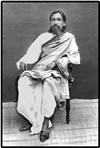
We give below a translation of two of Nammalwar’s poems.
TARAN, renowned as Nammalwar (“Our Saint”) among the Vaishnavas and the greatest of their saints and poets, was born in a small town called Kuruhur, in the southernmost region of the Tamil country — Tiru-nelveli (Tinnevelly). His father, Kari, was a petty prince who paid tribute to the Pandyan King of Madura. We have no means of ascertaining the date of the Alwar’s birth, as the traditional account is untrustworthy and full of inconsistencies. We are told that the infant was mute for several years after his birth. Nammalwar renounced the world early in life and spent his time singing and meditating on God under the shade of a tamarind tree by the side of the village temple.
It was under this tree that he was first seen by his disciple, the Alwar Madhura-kavi, — for the latter also is numbered among the great Twelve, “lost in the sea of Divine Love”. Tradition says that while Madhura-kavi was wandering in North India as a pilgrim, one night a strange light appeared to him in the sky and travelled towards the South. Doubtful at first what significance this phenomenon might have for him, its repetition during three consecutive nights convinced him that it was a divine summons and where this luminous sign led he must follow. Night after night he journeyed southwards till the guiding light came to Kuruhur and there disappeared. Learning of Nammalwar’s spiritual greatness he thought that it was to him that the light had been leading him. But when he came to him, he found him absorbed in deep meditation with his eyes fast closed and although he waited for hours the Samadhi did not break until he took up a large stone and struck it against the ground violently. At the noise Nammalwar opened his eyes, but still remained silent. Madhura-kavi then put to him the following enigmatical question, “If the little one (the soul) is born into the dead thing (Matter)1 what will the little one eat and where will the little one lie?” to which Nammalwar replied in an equally enigmatic style, “That will it eat and there will it lie.”
Subsequently Nammalwar permitted his disciple to live with him and it was Madhura-kavi who wrote down his songs as they were composed. Nammalwar died in his thirty-fifth year, but he has achieved so great a reputation that the Vaishnavas account him an incarnation of Vishnu himself, while others are only the mace, discus, conch etc. of the Deity.
From the philosophical and spiritual point of view, his poetry ranks among the highest in Tamil literature. But in point of literary excellence, there is a great inequality; for while some songs touch the level of the loftiest world-poets, others, even though rich in rhythm and expression, fall much below the poet’s capacity. In his great work known as the Tiru-vay-moli (the Sacred Utterance) which contains more than a thousand stanzas, he has touched all the phases of the life divine and given expression to all forms of spiritual experience. The pure and passionless Reason, the direct perception in the high solar realm of Truth itself, the ecstatic and sometimes poignant love that leaps into being at the vision of the “Beauty of God’s face”, the final Triumph where unity is achieved and “I and my Father are one” — all these are uttered in his simple and flowing lines with a strength that is full of tenderness and truth.
The lines which we translate below are a fair specimen of the great Alwar’s poetry; but it has suffered considerably in the translation, — indeed the genius of the Tamil tongue hardly permits of an effective rendering, so utterly divergent is it from that of the English language.
1 The form of the question reminds one of Epictetus’ definition of man, “Thou art a little soul carrying about a corpse.” Some of our readers may be familiar with Swinburne’s adaptation of the saying, “A little soul for a little bears up the corpse which is man.”
Hymn of the Golden Age
’Tis glory, glory, glory! For Life’s hard curse has expired; swept out are Pain and Hell, and Death has nought to do here. Mark ye, the Iron Age shall end. For we have seen the hosts of Vishnu; richly do they enter in and chant His praise and dance and thrive. (1)
We have seen, we have seen, we have seen — seen things full sweet for our eyes. Come, all ye lovers of God, let us shout and dance for joy with oft-made surrenderings. Wide do they roam on earth singing songs and dancing, the hosts of Krishna who wears the cool and beautiful Tulsi, the desire of the Bees. (2)
The Iron Age shall change. It shall fade, it shall pass away. The gods shall be in our midst. The mighty Golden Age shall hold the earth and the flood of the highest Bliss shall swell. For the hosts of our dark-hued Lord, dark-hued like the cloud, dark-hued like the sea, widely they enter in, singing songs, and everywhere they have seized on their stations. (3)
The hosts of our Lord who reclines on the sea of Vastness, behold them thronging hither. Meseems they will tear up all these weeds of grasping cults. And varied songs do they sing, our Lord’s own hosts, as they dance falling, sitting, standing, marching, leaping, bending. (4)
And many are the wondrous sights that strike mine eyes. As by magic have Vishnu’s hosts come in and firmly placed themselves everywhere. Nor doubt it, ye fiends and demons, if, born such be in our midst, take heed! ye shall never escape. For the Spirit of Time will slay and fling you away. (5)
These hosts of the Lord of the Discus, they are here to free this earth of the devourers of Life, Disease and Hunger and vengeful Hate and all other things of evil. And sweet are their songs as they leap and dance extending wide over earth. Go forth, ye lovers of God and meet these hosts divine; with right minds serve them and live. (6)
The Gods that ye fix in your minds, in His name do they grant you deliverance. Even thus to immortality did the sage Markanda attain. I mean no offence to any, but there is no other God but Krishna. And let all your sacrifices be to them who are but His forms. (7)
His forms he has placed as Gods to receive and taste the offerings that are brought in sacrifices in all the various worlds. He our divine Sovereign on whose mole-marked bosom the goddess Lakshmi rests — His hosts are singing sweetly and deign to increase on earth. O men, approach them, serve and live. (8)
Go forth and live by serving our Lord, the deathless One. With your tongues chant ye the hymns, the sacred Riks of the Veda, nor err in the laws of wisdom. Oh, rich has become this earth in the blessed ones and the faithful who serve them with flowers and incense and sandal and water. (9)
In all these rising worlds they have thronged and wide they spread, those beauteous forms of Krishna — the unclad Rudra is there, Indra, Brahma, all. The Iron Age shall cease to be — do ye but unite and serve these. (10)
Love-Mad
The Realisation of God in all things by the
Vision of Divine Love
The poetic image used in the following verses is characteristically Indian. The mother of a love-stricken girl (symbolising the human soul yearning to merge into the Godhead) is complaining to her friends of the sad plight of her child whom love for Krishna has rendered “mad” — the effect of the “madness” being that in all things she is able to see nothing but forms of Krishna, the ultimate Spirit of the universe.
Seated, she caresses Earth and cries “This Earth is Vishnu’s;”
Salutes the sky and bids us “behold the Heaven He ruleth;”
Or standing with tear-filled eyes cries aloud “O sea-hued Lord!”
All helpless am I, my friends, my child He has rendered mad. (1)
Or joining her hands she fancies “the Sea where my Lord reposes!”
Or hailing the ruddy Sun she cries: “Yes, this is His form,”
Languid, she bursts into tears and mutters Narayan’s name.
I am dazed at the things she is doing, my gazelle, my child shaped god-like. (2)
Knowing, she embraces red Fire, is scorched and cries “O Deathless!”
And she hugs the Wind; “’Tis my own Govinda,” she tells us.
She smells of the honied Tulsi, my gazelle-like child. Ah me!
How many the pranks she plays for my sinful eyes to behold. (3)
The rising moon she showeth, “’Tis the shining gem-hued Krishna!”
Or, eyeing the standing hill, she cries: “O come, high Vishnu!”
It rains; and she dances and cries out “He hath come, the God of my love!”
O the mad conceits He hath given to my tender, dear one! (4)
The soft-limbed calf she embraces, for “Such did Krishna tend,”
And follows the gliding serpent, explaining “That is His couch.”
I know not where this will end, this folly’s play in my sweet one
Afflicted, ay, for my sins, by Him, the Divine Magician. (5)
Where tumblers dance with their pots, she runs and cries “Govinda;”
At the charming notes of a flute she faints, for “Krishna, He playeth.”
When cowherd dames bring butter, she is sure it was tasted by Him, —
So mad for the Lord who sucked out the Demoness’ life through her
bosom! (6)
In rising madness she raves, “All worlds are by Krishna made”
And she runs after folk ash-smeared; forsooth, they serve high Vishnu!
Or she looks at the fragrant Tulsi and claims Narayan’s garland.
She is ever for Vishnu, my darling, or in, or out of her wits. (7)
And in all your wealthy princes she but sees the Lord of Lakshmi.
At the sight of beautiful colours, she cries, “O my Lord
world-scanning!” And all the shrines in the land, to her, are shrines of Vishnu. In awe and in love, unceasing, she adores the feet of that Wizard. (8)
All Gods and saints are Krishna — Devourer of infinite Space!
And the huge, dark clouds are Krishna; all fain would she fly to reach
them. Or the kine, they graze on the meadow and thither she runs to find Him. The Lord of Illusions, He makes my dear one pant and rave. (9)
Languid she stares around her or gazes afar into space;
She sweats and with eyes full of tears she sighs and faints away;
Rising, she speaks but His name and cries, “Do come, O Lord.”
Ah, what shall I do with my poor child o’erwhelmed by this maddest
love? (10)
|
|