|
The
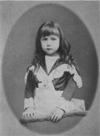
Mother was born in Paris on 21 February 1878 at 10.15 a.m. The
house of her parents was at the boulevard Haussmann near the Opera.
Her father, Maurice Alfassa, was a Turkish banker from Adrianople,
whilst her mother, Mathilde Ismaloun, came from Cairo. The Mother
was thus of Turkish- Egyptian descent, a fact which is significant
in so far as these two countries are on the threshold between
Orient and Occident. It became evident later that the Mother,
like no one else, knew how to bring together these two worlds
in a happy synthesis.
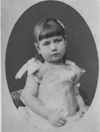
She was given the name Mirra and grew up in
Paris where she was to spend the first part of her life. Her parents
had moved to France a year before her birth and settled down there.
Even in her early years Mirra became conscious
of her special purpose of life, her mission on earth: "I
started contemplating or doing my Yoga from the age of 4.
There was a small chair for me on which I used to sit still,
engrossed in my meditation. A very brilliant light would then
descend over my head and produce some turmoil inside my brain.
Of course I understood nothing, it was not the age for understanding.
But gradually I began to feel, 'I shall have to do some tremendously
great work that nobody yet knows.' ( Utterances of the Mother
on herself which have been remembered and recorded by her disciples)"
From the age of five she was conscious that she did not belong
to this world and did not have a human consciousness. At this
age she began her spiritual discipline, her sadhana. But her mother
, who was a rationalist, knew little of what was going on in Mirra's
mind. Once she asked her, when she was meditating in her small
chair, "Why do you sit thus with a set face, as if the whole
world were pressing upon you?" And prompt came the answer,
"Yes, indeed, I do feel the weight of the world's miseries
pressing upon me!"
Mirra
soon developed her own interests. Once she told some students
in the Sri Aurobindo Ashram how she was trying to find out even
at a young age what forces were working on her and moving her,
and how she made an effort to achieve inner clarity and freedom.
"It is a rather unpleasant sensation to feel yourself
pulled by the strings and made to do things whether you want to
or not -that is quite irrelevant - but to be compelled to act
because something pulls you by the strings, something which you
do not even see -that is exasperating. ..I knew nobody who could
help me and I did not have the chance that you have, someone who
can tell you: 'This is what you have to do!' There was nobody
to tell me that. I had to find it out all by myself. And I found
it. I started at five. "
Whilst
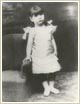
Mirra was thus developing her inner experiences, she had to fulfill,
externally, the demands of society. She learnt to read and write,
went to school and wondered at many strange things in the life
of grown-up people. Once when she was carefully dressed up in
order to pose for a photo, she looked with astonishment at the
older people around her and told herself, "But how childish
all this is!"
At
the age of eight she started practising a sport which was to play
a daily role at a later stage in her life, that is, tennis. In
order to make quick progress she used a special method: instead
of playing with her comrades of the same age, she chose older
players who were more experienced. It disturbed her little that
with this method she always lost: "I never won, but I learnt
much."
At
the age of about 12 we find her on lonely walks in the forests
of Fontainebleau near Paris. "It was a very old forest,where
there were trees that were even 2000 years old. I would sit quietly
under a tree going deep into meditation. At that time I often
felt a close intimacy with those trees that gave me great joy.
My consciousness came into communion with those trees, and even
the birds and squirrels from them would come down, very close
to me and fearlessly run across my body in a playful mood. ..Once
there was talk of cutting down an old tree, and when I went under
this tree, I distinctly felt that the tree had become aware of
its danger and was soliciting me to somehow stop this cruelty.
"
Another time it happened that while climbing
up a steep slope she slipped and fell. While falling, it was as
if someone was supporting her and bringing her down slowly. Her
comrades were happily surprised to see her safely arriving on
the street which was covered with sharp black flint stones.
At the same age Mirra also started developing
interest in occultism. Her inner experiences assumed new dimensions
now: "Between the ages of 11 and 13 a series of psychic
and spiritual experiences revealed to me not only the existence
of God, but man's possibility of uniting with Him, of realising
Him integrally in consciousness and action, of manifesting Him
upon earth in a life divine. This, along with a practical discipline
for its fulfilment, was given to me during my body's sleep by
several teachers, some of whom I met afterwards on the physical
plane. Later on, as the interior and exterior development proceeded,
the spiritual and psychic relation with one of these Beings became
more and more clear and frequent. "
Although Mirra knew little of Indian philosophy and religion at
that time, she called the special Being 'Krishna '. She
made a sketch of him and was firmly convinced that one day she
would meet him on earth.
Another revealing experience has been recorded by
her in her
Prayers and Meditations.
"When I was a child of about thirteen, for nearly a year
every night as soon as I had gone to bed it seemed to me that
I went out of my body and rose straight up above the house, then
above the city, very high above. Then I used to see myself clad
in a magnificent golden robe, much longer than myself; and as
I rose higher, the robe would stretch, spreading out in a circle
around me to form a kind of immense roof over the city. Then I
would see men, women, children, old men, the sick, the unfortunate
coming out from every side; they would gather under the outspread
robe, begging for help, telling of their miseries, their suffering,
their hardships. In reply, the robe, supple and alive, would extend
towards each one of them individually, and as soon as they had
touched it, they were comforted or healed, and went back into
their bodies happier and stronger than they had come out of them.
"
But life for Mirra was not one-sidedly an inner
life only. She could be firm and resolute if it was the question
of fighting for the Truth or protecting comrades. Here are two
incidents to illustrate the point.
Once at the age of seven she had to face a thirteen-year
old bully who used to insult and molest girls. One day she asked
him, 'Will you shut up now?' When he continued with his insults,
she suddenly caught hold of him, lifted him up and threw him to
the ground. A supernatural force had descended into her. The Mother
later explained that it was Mahakali, the divine warrior force.
At the age of fifteen she joined a big studio
to learn drawing and painting. She calmly concentrated on her
work and the others called her the Sphinx. It often happened that
fellow students came to her to take her advice or make her settle
some quarrel. Once Mirra took up the case of a monitress who had
got into the bad books of the old lady who was the Head of the
Studio and who wanted to send her away. Mirra knew that this would
mean for the poor girl the end of her career. So she approached
the Head of the Studio and pleaded for the monitress. When her
rational arguments fell on deaf ears, Mirra caught the hand of
the old lady and held it in such a firm grip that she quickly
changed her mind. The monitress was allowed to stay on.
A school essay which Mirra wrote at the age of fifteen
has been luckily preserved. It is entitled 'The
Path of Later on'. A young student gets disenchanted with
his homework and decides to postpone it until the next day. He
goes to sleep and has a dream in which he finds himself standing
at a crossroads. Enticed by sweet fragrances and the warm sun
which is shining there he chooses the easy path in spite of warning
voices. Then at the end he lands in a kind of ghost-kingdom and
faces a deep abyss. When he is just about to succumb, he wakes
up and his nightmare is finished. He makes a resolve never to
follow again the 'Path of Later on' and not to leave until tomorrow
what he can do today....
More>>
For
More Details see :

|