|

Diary notes and Meeting with
Sri Aurobindo
Sri Aurobindo's complete works (Centenary Edition) comprise 29
volumes (plus an index volume). The major part of these works
are texts which were written by him, even though there
are also the transcripts of a few speeches. Furthermore, a few
disciples like Nirodbaran or A.B. Purani have recorded some talks
with him on the basis of notes. But he was mainly communicating
himself through the pen (or the typewriter), and his voice has
not been recorded. Just the reverse is the case with the Mother.
Out of the 15 volumes of her Collected Works most contain transcripts
of her speeches and talks with students, the greatest part of
which were recorded on tape. The Mother's only written work of
some length is Prayers
and Meditations, a selection from her comprehensive diary
notes. Their origin goes back to the year 1912, when she was regularly
meditating in the early morning in her room at rue Val de Grace
in Paris. Sitting near the window with a Kashmiri shawl around
her shoulders, she entered into communion with the Divine and
noted her experiences in a diary. Extracts from this diary were
published in 1932 under the title Prieres et Meditations, and
Sri Aurobindo himself translated many of the entries into English.
In the preface the Mother explains the purpose
of this publication. The texts are meant to help those "who
have undertaken to achieve self-mastery, those who want to find
the path that leads to the Divine, and those who aspire to consecrate
themselves more and more completely to the Divine Work. "
After
a few years the Mother had dissolved her marriage with A. Morisset
and she married Paul Richard, a well-known and well-read philosopher
who was keenly interested in Eastern and Western spirituality
as well as Vedantic Yoga. He had also political plans and so in
1910, in connection with an election campaign, he came to Pondicherry
, which was at that time part of French India. He also wanted
to consult an advanced Yogi about the symbolic meaning of the
star of David and therefore went to see Sri Aurobindo who was
in exile outside British India. In what follows we shall first
give a short survey of Sri Aurobindo's life, which was later to
merge more and more with that of the Mother .
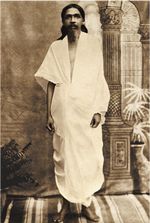
Sri Aurobindo was born in Calcutta on 15 August 1872.
His father was an anglophile and sent him with his two brothers
to England for education when he was seven. Sri Aurobindo spent
fourteen years in that country .He first stayed with an English
family at Manchester, then he joined St. Paul's School in London
and later studied at King's College in Cambridge. He passed the
open competition for the Indian Civil Service, but got himself
disqualified by not presenting himself at the riding examination.
In 1893 Sri Aurobindo returned to India, and
the next thirteen years he worked in Baroda in the Revenue Department
and the Secretariat, then as a Professor at the Baroda College
and, finally, as Vice-Principal there. During this period he studied
keenly the basics of Indian culture, learnt Sanskrit as well as
some modern Indian languages and wrote many poems. In 1905 he
joined the political arena and the next year became editor of
the journal Bande Mataram. In numberless inspired articles
he sought to stir up the Indian national consciousness and to
further the independence movement. At Baroda in early 1908 he
had the experience of Nirvana or silent Brahman. Later in the
year at Calcutta he was arrested in a conspiracy case and detained
for one year as an undertrial prisoner in the Alipur Jail. There
he had his second decisive spiritual experience and saw God (Krishna)
present in all things and beings, moving in them and expressing
Himself through them. After his acquittal in 1909 he continued
for a while in politics. The next year he withdrew from the political
field. Following an inner command, he sailed first to Chandernagore
and later to Pondicherry where he completely devoted himself to
developing a new path of spirituality, the Integral Yoga. Richard
had several meetings with Sri Aurobindo and one of his questions
related to the symbolic character of the lotus. Sri Aurobindo
explained that the lotus represents the opening of the consciousness
to the Divine. .
When Richard had returned to France, he told
the Mother about Sri Aurobindo and they started some correspondence.
In April 1914 Sri Aurobindo wrote to a friend that the
Richards were rare examples of European yogins who had not been
misled by aberrations on the spiritual path.
The Mother felt now irresistibly drawn towards
India, the one country which she had always felt to be her true
mother country. In 1914 her longing was at last fulfilled
and she could embark on a journey to Pondicherry with Paul Richard.
They left Paris on 5 March, 1914 and the next day they boarded
the , Kaga Maru ' , a Japanese steamer. In a diary note
of March 8 the Mother describes an inner experience, an inner
movement which is characteristic of her being and points towards
her future role: she takes all fellow-travellers on the boat into
her consciousness and envelopes them in love, tries to awaken
them to the Divine. In her inner experience the boat is
"a marvellous abode of peace, a temple sailing in Thy honour
over the waves of the subconscient passivity which we have to
conquer and awaken to the consciousness of Thy divine Presence.
"
On Sunday a service was arranged in the saloon of the boat, but
the Mother did not take part in it. When the priest asked her,
why she had not come, she answered: "... I don't feel that
you are sincere, neither you nor your flock. You all went there
to fulfil a social duty and social custom, but not
at all because you really wanted to enter into communion
with God. "
When the priest told her that he was on the way to China as a
missionary , the Mother did not mince Words in giving him
her opinion on his mission: "Listen, even before your religion
was born not even two thousand years ago the Chinese had a very
high philosophy and knew a path leading them to the Divine; and
when they think of Westerners, they think of them as barbarians.
And you are going there to convert those who know more about it
than you? What are you going to teach them? To be insincere, to
perform hollow ceremonies instead of following a profound philosophy
and a detachment from life which lead them to a more spiritual
consciousness?"
The Mother and Paul Richard
left the boat at Colombo and arrived in Pondicherry in
the early hours of March 29. Even while approaching the
town, the Mother had a vision of a huge column of light in the
centre of Pondicherry , and the intensity of the light became
greater when they got down at the railway station.
On the very day of their arrival the Richards
met Sri Aurobindo in the afternoon at his place in rue Fransçois
Martin. The first physical meeting with Sri Aurobindo was a decisive
experience for the Mother and she immediately recognized in him
the one whom she had so often met in her dreams and whom she had
called 'Krishna '. She was now deeply convinced that her place
was at his side, that her work was here in India. After the meeting
she noted in her diary; ..It matters little that there are
thousands of beings plunged in the densest ignorance; He whom
we saw yesterday is on earth; his presence is enough to prove
that a day will come when darkness shall be transformed into light,
and Thy reign shall actually be established upon earth. "
The Mother had sat down at Sri Aurobindo's feet and
made her mind completely empty, giving up all her ideas and concepts,
in order to be completely open only to him. After some time an
infinite silence had descended into her and settled in her mind.
This experience brought about a deep inner change in her: "It
seems to me that I am being born into a new life and that all
the methods and habits of the past can no longer be of any use.
It seems to me that what was once a result is now only a preparation.
..It is as if I was stripped of all my past, of my errors as well
as my conquests, as if all that had disappeared to give place
to one new-born whose whole existence has yet to take shape. ..An
immense gratitude rises from my heart. I seem to have at last
arrived at the threshold which I have long sought. "
The Richards now met Sri Aurobindo every afternoon,
whilst he came to the Richards on Sundays and his companions joined
him for dinner with the Richards after their daily football game.
The talks often continued until late in the night.
The Richards now started publishing a philosophical
journal, the Arya, in collaboration with Sri Aurobindo.
Sri Aurobindo contributed many articles in which he propounded
his own interpretation of important Indian Scriptures such as
the Vedas and Upanishads, and he wrote about Indian Philosophy
as well as world history and world evolution. Here he laid the
foundation for some of his major works like The
Life Divine, The
Synthesis of Yoga, The Secret of the Veda, The Human Cycle,
etc. Richard made his contribution with a collection of aphorisms
of famous thinkers, poets, saints and sages, whilst the Mother-
the actual collector of them in the past -maintained the accounts
and was the chief executive. They also prepared a French edition
(Revue de la Grande Synthese). The first edition of the
Arya appeared on Sri Aurobindo's birthday, 15 August 1914,
and it was like a message of Light for the world which had just
been precipitated into the chaos of the First World War. The aims
of this monthly journal were given as follows on the cover page:
1. The systematic study of the highest problems
of existence.
2. The formation of a vast synthesis of knowledge, harmonising
the diverse religious traditions of humanity, occidental as well
as oriental. Its method will be that of realism, at once rational
and transcendental, a realism consisting in the unification of
intellectual and scientific disciplines with those of intuitive
experience.
While the first copies of the Arya were going
out into the world, Paul Richard was called home to join the French
Reserve Army and had to leave Pondicherry .The Mother went with
him, certainly against her will. But obviously Sri Aurobindo felt
that the time for their direct collaboration had not yet come.
So they started the return journey on 22 February 1915, one day
after the Mother's birthday. She later stated in one of her talks,
with obvious pain: "He (Sri Aurobindo) did not keep me, what
could I do? I had to go. But I left my psychic being with him,
and in France I was once on the point of death: the doctors had
given me Up." The separation from Sri Aurobindo, from India
was a powerful shock for the Mother. She was drawn, as it were,
into the whirlpool of the World War to become its silent witness.
In Paris she saw trains with wounded soldiers arriving and was
deeply moved on seeing the noble manner in which they bore their
sufferings. She tried to help them in her own way, by inwardly
enveloping them in love, and she discovered that the soldiers
had a great receptivity for her invisible gift.
There are a great number of diary entries of this
time which reflect the tumultuous developments in the world as
well as her own trials.
"0 Lord, this earth groans and suffers; chaos
has made this world its abode.
"The darkness is so great that Thou alone
canst dispel it. Come, manifest Thyself, that Thy work may be
accomplished. "
"Solitude, a harsh, intense solitude, and
always this strong impression of having been flung headlong into
an inferno of darkness! ...Sometimes... I cannot prevent my total
sub- mission from taking a hue of melancholy, and the calm and
mute converse with the Master within is transformed for a moment
into an invocation almost suppliant, '0 Lord, what have I done
that Thou throwest me thus into the sombre night?' "
Meanwhile Sri Aurobindo continued his correspondence
with the Mother and helped her in her serious crisis. After the
departure of the Richards he shouldered all alone the responsibility
of publishing the Arya. He wrote 64 pages every month.
After it had been proposed to him to seek a safer place for his
stay than Pondicherry , he wrote the Mother in a letter of 6 May
1915: "The whole earth is now under one law and answers to
the same vibrations and I am sceptical of finding any place where
the clash of struggle will not pursue us. In any case, an effective
retirement does not seem to be my destiny. I must remain in touch
with the world until I have either mastered adverse circumstances
or succumbed or carried on the struggle between the spiritual
and physical so far as I am destined to carry it on."
During her serious illness the Mother was staying
in Lunel and she noted in her diary on 19 April 1915 how all external
circumstances were just then representing the very opposite of
her ideal of a harmonious world. "The hour has not yet come
for joyful realisations in outer physical things, " she writes
with a view of the gloomy situation. But she silently submits
to her suffering and accepts it to be the will of the Lord that
she has to share this experience of the complete darkness of the
world, which takes her physically to the verge of death. And yet
she remains uashaken in her resolve, in her deep aspiration for
a truer life on earth, and keeps the flame of her faith burning
amidst the hopeless chaos of the holocaust. Whilst her body has
been put out of action by an inflammation of the nerves, she carries
her work on in the inner planes which are out of reach for the
clutches of Death. In the following quotation we learn something
about the multi-dimensional workings of the Mother and come to
know how she could further and hasten the evolution and individual
development of seekers of the Truth, independent of her body:
"I was lying in an easy-chair, in front of
a garden. I saw that the spiritual power was still active in me:
I could go on with occult experiments in spite of the illness.
I used to concentrate on things and persons and circumstances
and wanted to see if the power worked. It worked very well on
the mental and vital planes. Then I broadened the field of activity.
I could go on doing my work in various parts of France and America
and other places. I could clearly see the faces of the persons
worked upon. They could be made to do what they by themselves
could not. These were controlled experiments.
"I could see that nothing could stop the work:
even without my body the work could go on.
"Wherever the call was, I could attend."
On the strength of this quotation we may surely assume
and affirm that now after her physical departure, the Mother is
in a similar way influencing earth events from the subtle physical
plane and giving individual guidance to disciples and devotees
allover the world. "Even without my body the work could
go on." this is certainly a most significant revelation.
For
More Details see :

|