|
The
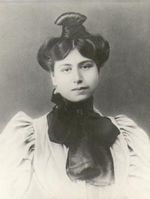
Mother grew up in Paris, the metropolis of the great painters
of Impressionism; it was the time when artists like Matisse, Manet
or Cezanne rose to world-fame. In this very milieu she lived and
moved among the cultural avantgarde of the time. She had finished
her studies at the Ecole des Beaux Arts and some of her paintings
had been exhibited in the Salon. At the age of nineteen,
on 13 October 1897, she married Henri Morisset, a disciple of
the painter Gustave Moreau. Her son Andre was born on 23 August
1898.
The Mother's talks with young students in the
Ashram in Pondicherry reflect her intimate knowledge of the milieu
of Parisian artists. Once she related the story of a talented
painter who belonged to the circle of Gustave Moreau. We render
it in the following because it is rather interesting from the
viewpoint of the history of Arts and throws new light on a disputed
subject.
"I knew a painter, a disciple of Gustave
Moreau; he was truly a very fine artist, he knew his work quite
well, and then. .. he was starving, he did not know how to make
both ends meet and he used to lament." Then one day, the
Mother continues, a well-wishing friend sent a picture-dealer
to his studio. The latter inspected all his works, without discovering
anything of interest: the works of the painter were simply not
fashionable and therefore without commercial value. But at last
the dealer found a canvas with some palette-scrapings in a dusty
corner and was suddenly full of enthusiasm: "Here you are!
my friend, you are a genius, this is a miracle, it is this you
should show! Look at this richness of tones, this variety of forms,
and what an imagination!"
Now the poor man who was starving, objected shyly, "But,
sir, these are my palette- scrapings!" The art-dealer caught
hold of him: "Silly fool, this is not to be told!"
Then he continued: "Give me this, I undertake to sell it.
Give me as many of these as you like; ten, twenty, thirty a month,
I shall sell them all for you and I shall make you famous. "
The artist was not exactly fond of this idea, but since he was
in dire need of financial support, he agreed to the proposal and
started producing pictures not with palette-scrapings, but with
mixed and brilliant colours which did not have very precise forms
and gave free play to the imagination of the people. The Mother's
conclusion of this episode may shock many an art expert: "He
never made a name for himself with his real painting, which was
truly fine (it was really very fine, he was a very good painter),
but he won a world reputation with these horrors!
Another interesting report is about Cezanne
who was also residing in Paris at this time. The Mother mentions
his peculiarity to do still-lives in which plates were never round
and were therefore objected to by many critics. But when friends
asked him why he was painting like that, he answered, according
to the Mother: "My dear fellow, you are altogether mental,
you are not an artist, it is because you think that you make your
plates round: if you only see, you will do it like this (gesture)."
The Mother explained the point: "It is in accordance
with the impression that the plate ought to be painted; it gives
you an impact, you translate the impact, and it is this which
is truly artistic. It is like this that modern art began. And
note that he was right. His plates were not round, but he was
right in principle. "
Thus the Mother spent ten years of her life in this
creative environment of highly gifted artists and became deeply
acquainted with their ways. A student in the Ashram once posed
the interesting question why artists had so often rather loose
morals, and the Mother answered: "They do not feel bound
by the customary rules of conduct and have not yet found an
inner law that would replace them. " But she pointed out
that all artists whom she had known had been of this kind. Some
were absolutely 'bourgeois', married, good fathers and husbands
who followed a strict moral code.
Whilst Sri Aurobindo's main interests in the early
stages of his development were literature, poetry, languages and
history , for the Mother they were, no doubt, art and music. But
these were to her forms of expression which led to something deeper
or revealed something hidden within: the search for God and spiritual
realization were her sole objective in all things, and she was
almost entirely left to herself in this pursuit. Only rarely did
it happen that she received some effective help in the form of
a book or a person: "Between the age of eighteen and twenty
I had attained a conscious and constant union with the divine
Presence and. ..I had done it all alone, with absolutely
nobody to help me, not even books, you understand! When I
found one- I had in my hands a little later Vivekananda's Raja
Yoga -it seemed to me so wonderful a thing, you see, that
someone could explain something to me! This made me gain in a
few months what would have perhaps taken me years to do. "
When the Mother was about 21, she met an Indian
who gave her a copy of the Bhagavadgita. It was only a very inadequate
French translation, but she could perceive, by intuition, the
true content of this Indian scripture. The Indian advised her
to envisage Krishna as the immanent Godhead, as the Divine within
ourselves, and to read the Gita with this knowledge. The Mother
followed his advice and in one month the whole work was done.
she had got the experience of Krishna as .immanent God.
The
Mother later explained to her students that the Gita was an important
scripture which elucidated an important Truth, and yet one thing
was missing in it: the idea of the transformation of the outer
nature of man, which is one main object of Sri
Aurobindo's Integral Yoga.
For
More Details see :

|